Which Copy of the Book of Five Rings Did Jocko Read?
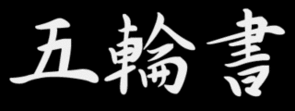
The Volume of Five Rings ( 五輪書 , Go Rin no Sho ) is a text on kenjutsu and the martial arts in general, written past the Japanese swordsman Miyamoto Musashi around 1645. There accept been various translations made over the years, and it enjoys an audience considerably broader than merely that of martial artists and people across E Asia: for example, some foreign business organization leaders discover its give-and-take of conflict and taking the reward to be relevant to their work in a business context. The modern-twenty-four hours Hyōhō Niten Ichi-ryū employs information technology equally a manual of technique and philosophy.
Musashi establishes a "no-nonsense" theme throughout the text. For case, he repeatedly remarks that technical flourishes are excessive, and contrasts worrying about such things with the principle that all technique is merely a method of cutting downwardly 1's opponent. He besides continually makes the signal that the understandings expressed in the volume are of import for combat on any scale, whether a one-on-one duel or a massive battle. Descriptions of principles are often followed by admonitions to "investigate this thoroughly" through practice rather than trying to larn them past merely reading.
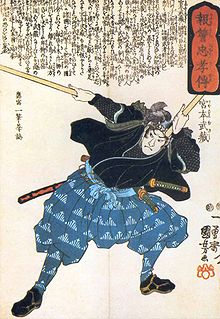
Musashi describes and advocates a ii-sword fencing mode (nitōjutsu): that is, wielding both katana and wakizashi, contrary to the more traditional method of wielding the katana two-handed. However, he only explicitly describes wielding 2 swords in a department on fighting against many adversaries. The stories of his many duels rarely refer to Musashi himself wielding 2 swords, although, since they are mostly oral traditions, their details may be inaccurate. Musashi states inside the volume that one should train with a long sword in each hand, thereby grooming the body and improving one's power to use two blades simultaneously.
The five books [edit]


Although it is difficult to grasp it from the volume, Become Rin No Sho, these books are actually the teachings which Musashi preached to his students in his own dōjō. Though ideas are taken from other sources, the text is predominantly seminal.
The five "books" refer to the idea that there are unlike elements of battle, merely every bit there are different physical elements in life, as described by Buddhism, Shinto, and other Eastern religions. The five books beneath are Musashi's descriptions of the verbal methods or techniques which are described by such elements.
The term "Ichi School" is referred to in the book, Go Rin No Sho. When referring to such books, it refers to "Niten No Ichi Ryu" or "Ni-Ten Ichi Ryu", which literally translates to, "Two Heavens, One School". Alternative translations include: "Two Swords, One Spirit", and "2 Swords, 1 Entity". The translation, "Two Swords, One Dragon" was thought to be a misinterpretation of the Kanji word Ryu.[ commendation needed ]
- The Book of World chapter serves equally an introduction, and metaphorically discusses martial arts, leadership, and training as building a house.
- The Volume of Water chapter describes Musashi's style, Ni-x ichi-ryu, or "Two Heavens, 1 Mode". It describes some basic technique and fundamental principles.
- The Book of Burn down affiliate refers to the rut of battle, and discusses matters such as dissimilar types of timing.
- The Volume of Wind chapter is something of a pun, since the Japanese character for "wind" and can also hateful "style" (due east.one thousand., of martial arts). It discusses what Musashi considers to be the failings of diverse contemporary schools of sword fighting.
- The Volume of the Void chapter is a curt epilogue, describing, in more esoteric terms, Musashi'southward (probably) Zen-influenced thoughts on consciousness and the correct mindset.
The Book of Globe [edit]
The Globe book,[1] according to "Go Rin No Sho", refers expressly to the strategy taught by Musashi at the Ichi School. Information technology is said to be how to distinguish the Way through "Sword-Fencing", or "Swordsmanship". The idea of strategy would be encouraged to be very astute in their study and strategy:
Know the smallest things and the biggest things, the shallowest things and the deepest things. As if it were a direct road mapped out on the ground... These things cannot exist explained in detail. From ane affair, know ten thousand things. When you attain the Way of Strategy at that place will not exist one thing you cannot come across. You lot must report hard.
Upon their mastery of the strategy and timing listed in the 5 books, Musashi states that people volition be able to defeat ten men as easily as they could defeat one, and asks: "When yous accept reached this point, volition it not mean that y'all are invincible?"
The strategies listed in this discipline or book relate to situations requiring different weapons and tactics, such equally indoor weapons. Musashi states that the use of glaive-like naginata and spears are purely for the field, whereas the longsword and accompanying short-sword can exist used in most environments, such as on horseback or in vehement battle.
Musashi also remarks on the gun as having no equal on the battlefield, until swords clash, when it becomes useless. He does notation that the gun had the disadvantage of being unable to see a bullet and adapt aim as i would with a bow. He writes: "The bow is tactically stiff at the commencement of battle, especially battles on a moor, equally information technology is possible to shoot apace from among the spearmen. However, it is unsatisfactory in sieges, or when the enemy is more than than forty yards away. For this reason there are nowadays few traditional schools of archery. There is little employ for this kind of skill."
One of the principles of the Niten Ichi-ryū is that one should be versed in many weaponry skills. Musashi indicates that during battle one should not overuse one weapon—this is every bit bad equally using the weapon poorly, since it becomes like shooting fish in a barrel for an enemy to detect a weakness in 1's style after countless uses of the aforementioned weapon.
Timing, as explained past Musashi, is the core principle in strategy which is listed in Earth. The idea of timing as explained within the volume is that one must be able to accommodate i'southward strategy to timing with your skill, in that one must know when to attack and when not to assail.
In The Book of Five Rings he writes on timing:
"Timing is of import in dancing and pipe or cord music, for they are in rhythm merely if timing is good. Timing and rhythm are too involved in the armed forces arts, shooting bows and guns, and riding horses. In all skills and abilities there is timing.... There is timing in the whole life of the warrior, in his thriving and declining, in his harmony and discord. Similarly, in that location is timing in the Way of the merchant, in the rise and fall of capital. All things entail rising and falling timing. You must be able to discern this. In strategy there are various timing considerations. From the outset you must know the applicable timing and the inapplicable timing, and from among the big and small-scale things and the fast and boring timings find the relevant timing, first seeing the distance timing and the background timing. This is the primary thing in strategy. It is especially important to know the background timing, otherwise your strategy will become uncertain."
The Book of Earth ends with nine basic principles – the "ground" upon which the samurai must rely. These are "practical" or "worldly," each intended to help develop an understanding of strategy (while the other books focus on tactics and motility). These rules are for his students, and are complemented by the 21 "spiritual principles" for all to follow, which are establish in the Dokkōdō (Musashi'south terminal piece of work). The principles are:[ commendation needed ]
- "Do non think dishonestly."
- "The Mode is in training."
- "Get acquainted with every art."
- "Know the Ways of all professions."
- "Distinguish between proceeds and loss in worldly matters."
- "Develop an intuitive sentence and agreement for everything."
- "Perceive those things which cannot be seen."
- "Pay attention fifty-fifty to trifles."
- "Do nil which is of no use."
The Volume of Water [edit]
The water book concerns strategy, spirituality and philosophy. The meaning of water in relation to life is flexibility. Water demonstrates natural flexibility as it changes to conform with the boundaries which contain it, seeking the most efficient and productive path. Then too should one possess the power to change in accord with 1's own situation to hands shift between disciplines, methods, and options when presented with new data. A person should master many aspects of life allowing them to possess both balance and flexibility.
The spiritual bearing in strategy, which Musashi writes nigh concerns your temperament and spirituality whilst in the midst of, or in formulation of a battle. Being a buddhist, most of what is written in the section apropos spirituality refers to principles of calmness, tranquility and spiritual balance:
In strategy your spiritual bearing must not be whatsoever different from normal. Both in fighting and in everyday life you should exist adamant though calm.
This balance refers to what could be thought of equally yin and yang within ane person. The over-familiarity or over-use of one weapon is discouraged by Musashi, as information technology would exist seen to reveal one's spirituality to one's enemy. The thought is that a perfectly balanced spirit is also a perfectly balanced concrete presence, and neither creates weakness nor reveals it to an enemy.
During battle, the spirituality and balance is something of which Musashi notes that 1 should accept reward. Since small people know the spirituality of big people, they tin can thus note differences and weaknesses between each other. This is something which seems easy, but it is said to change when one is on the battlefield, as and then 1 must know to both adjust ane's spiritual residue according to the surrounding environs, and to perceive the residuum of others to take advantage accordingly.
Just as i'south spirit should be balanced, ane'south various techniques exist honed to a perfectly counterbalanced demeanor. In terms of stance, much like balance within the trooper, Musashi notes that stance is an of import part of strategy, or battle: Prefer a stance with the head cock, neither hanging downwardly, nor looking up, nor twisted. This is part of what Musashi notes as wedging in.
In regards to the gaze of someone, he notes that a person must exist able to perceive that which is all effectually him without moving their eyeballs noticeably, which is said to exist a skill which takes an enormous amount of practise to perfect. He notes that this is once again 1 of the almost important parts of strategy, as well every bit existence able to see things which are shut, such as the technique of an enemy. It is also used to perceive things far away, such as arriving troops or enemies, equally that is the precursor to battle. One can then modify ane's actions according to what one sees.
Attitudes of swordsmanship [edit]
- Upper
- Middle
- Lower
- Right Side
- Left Side
The five attitudes of swordsmanship are referred to as the v classifications of areas for set on on the human torso. These are areas which are noted for their advantages when hit at an enemy, and the strategist is said to think of them when in situations where, for any reason, they should not be able to strike them, and adjust accordingly.
Your attitude should exist large or small according to the situation. Upper, Lower and Middle attitudes are decisive. Left Side and Right Side attitudes are fluid. Left and Right attitudes should be used if there is an obstruction overhead or to 1 side. The decision to employ Left or Right depends on the place.
As each is thought of equally an attitude, it could be thought of that Musashi means to practice with each "attitude" and so that yous do not become over-reliant upon one, something which Musashi repeatedly notes as beingness worse than bad technique.
"No Attitude" refers to those strategists who exercise not go with the use of the "Five Attitudes" and prefer to just get without the attitudes of the long sword to focus entirely on technique, every bit opposed to focusing on both technique and the 5 attitudes. This is like to taking chances as opposed to making chances.
The attitude of "Existing – Non Existing", mixes the Five Attitudes with the Attitude of "No Mental attitude", meaning that the user of the longsword uses the techniques and principles of both at whichever moment is almost opportune.
"In-One Timing" refers to the technique of biding one'due south fourth dimension until a suitable gap can exist found in the enemies' defence force, to which ane will deliver ane fatal blow to the enemy. Although this is said to be difficult, Musashi notes that masters of this technique are usually masters of the 5 attitudes because they must exist perceptive of weaknesses. It is rumored that Musashi disgraced a former sword master past using such a technique with a bokken, but there are no descriptions mentioning "In i" timing.[ citation needed ]
"Abdomen Timing of Two" refers to feinting an attack, and then striking an enemy as they are retreating from the attack, hitting them in the abdomen with the correct timing of either two moves or two seconds. Although the technique seems relatively elementary, Musashi lists this as one of the hardest techniques to time correctly.
"No Blueprint, No Conception" refers to When word and deportment are spontaneously the same. Aside from this philosophical arroyo to the significant, the technique is relatively uncomplicated to explain: if yous are in a deadlock with the enemy, using the force from the cut, you button with your torso and employ the disciplines outlined in the Void Book to knock the enemy over.
This is the nigh important method of striking. It is often used. You must train hard to understand it.
"Flowing Water Cut" technique is relevant to a fight with an enemy of a similar level in swordsmanship. When attacking fast, Musashi notes that one will always exist at stalemate, and so similar stagnant water, one must cut as slowly equally possible with the long sword. At the beginning of this technique, both combatants will be searching for an opening within each other's defense. When the opponent either tries to push off the sword, or to hasten back every bit to disengage it, you must showtime expand your whole body and your mind. By moving your body first and and so that of your sword, you will be able to strike powerfully and broadly with a motion that seems to reflect the natural period of water. Ease and conviction volition be attained when this technique is continuously skilful upon.
"Continuous Cut" refers to when you are over again faced with stalemate within a duel, where your swords are clasped together. In one move, when your sword springs away from theirs, Musashi says to use a continuous motion to slash their caput, body, and legs.
"Fire and Rock's Cut" refers to when swords disharmonism together. Without raising the sword, cut every bit strongly equally possible. This ways cutting quickly with easily, body, and legs.
"Red Leaves Cut" refers to knocking downwardly the enemy's long sword in the spirit of the "No Pattern, No Conception" cut.[ commendation needed ]
The Book of Fire [edit]
The Burn down Volume refers to fighting methods different the specific fighting techniques listed in the H2o Volume. It goes into a broader scope in terms of hints as to assess a situation, likewise every bit specific situational instructions.
He notes obvious advantages of armor and preparedness before a duel or boxing equally it applies to one man or a whole group of men:
As one man can defeat ten men, and then can i k men defeat x thousand. However, yous tin can become a master of strategy by training lone with a sword, so that you lot can understand the enemy's stratagems, his strength and resource, and come to appreciate how to apply strategy to beat ten m enemies.
The dependence of location co-ordinate to the Go Rin No Sho is crucial. You must be in a identify where human-made objects such as buildings, towers, castles, and such do not obstruct your view, as well as facing or standing in a position where the sun or moon does not bear upon your vision. This is purely so that your vision is focused on nothing but the enemy, and thus there is more concentration upon the enemy's stratagems. Musashi besides seems to note the historic period old strategy of the High Ground:
You lot must wait downwardly on the enemy, and accept up your attitude on slightly higher places.
Other kinds of tactics which of Musashi tells are style of ensuring that the enemy is at a disadvantage. Forcing yourself on the not-dominant side of a trooper is i way because the left side is hard for a right-handed soldier. Other disadvantages, such as forcing enemies into footholds, swamps, ditches, and other difficult terrain, strength the enemy to be uncertain of his situation.
These things cannot be conspicuously explained in words. You must research what is written here. In these three means of forestalling, you must judge the situation. This does non mean that yous always attack showtime; but if the enemy attacks offset you can atomic number 82 him around. In strategy, you have effectively won when you forestall the enemy, so you lot must train well to attain this.
Ken No Sen (Attacking) is the virtually obvious method of forestalling an enemy because a head-on collision forces both parties to a standstill. Although it is not mentioned, Musashi must take been well enlightened that this method would also be the nearly likely to have a higher expiry count than the others due to the sheer mass of enemies because more one enemy could then assail a unmarried soldier or trooper.
As the name suggests, Tai No Sen (Waiting for the Initiative) is invented for very opportunistic and decided battles betwixt parties. The main idea beingness to feign weakness equally to open a weak spot, or Achilles' heel, in the opposing force, and so regrouping to exploit such a hole by attacking deep within the enemy's party. Although it is non mentioned, this would most likely be to impale the officer of the highest rank as an try to remove the tactical centre of a group of soldiers. A method particularly useful for Musashi or others, if attacking a general directly would signal the stop of the battle upon his defeat.
Only a small corporeality of text is written nigh Tai Tai No Sen (Accompanying and Forestalling). Albeit very confusing, the idea of Tai Tai No Sen is circumventing an deadfall or quick attack from the enemy by taking the initiative and attacking in full strength. Musashi admits himself that this is a difficult thing to explain.
Although there are other methods, they are mostly situational methods relating to the crossing of crude terrain, and contesting within such rough terrain. Although it spreads over ii or more paragraphs, most data is common sense, relating to circumspection and avoidance of such situations.
The thought of timing, as with singular battles, is known as the nearly important function of attacking next to the skill of participants. Still, the type of timing in this case is somewhat different from the timing noted in The Ground Book since this multifariousness of timing requires looking at the various concrete factors which impact an enemy during battle, such equally determining if forcefulness is waning or rising within a group of troopers.
The idea of treading down the sword is a very simple technique. Squashing an enemy's attack before it starts by using a form of charging and then attacking under the veil of gunpowder smoke, and pointer fire, the initial attacks used when starting battles can be highly effective. Individually, it refers to attacking the enemy's sword, breaking it, removing information technology from play, and a technique of controlling it through straight blade on blade contact.
Just as Musashi mentions in his philosophical style, there is a crusade for a plummet. As there is collapse within an enemy, such as waning in his numbers, Musashi notes that one must detect such events and utilise them to advantage.
He notes that an enemy's formation can autumn if they lose rhythm. It was known that in such battles, drummers drummed a melody for their other boyfriend soldiers to march to; and, if the rhythm was lost, information technology led to a "collapse when their rhythm becomes deranged".
The Book of Air current [edit]
Whereas most of the information given in the previous books is useful in such a way that it could all the same exist applicative today, this book is primarily concerned with the specific details about other strategies that existed at the fourth dimension. The broader lesson from this book is that an important part of understanding 1'southward own way is to understand the way of one'southward opponent as precisely as possible.
Musashi notes that although most schools accept secret and ancient strategies, almost forms are derivative of other martial arts. Their similarities and differences evolved through situational factors, such as indoor or outdoor dueling, and the style adjusted to the schoolhouse. He indicates that his appraisement may be one sided because the merely school he had interest for was his own, and, in a way, he does non see parallels to his own creation and piece of work. Still, he still admits that without basic agreement of these alternating techniques, i will not be able to learn Ni Ten Ichi Ryu, probably for reasons of finding the wrongs in other techniques, and righting them within yourself in Ni Ten Ichi Ryu.
The main divergence that Musashi notes between the Ichi School and other strategists and schools is that other schools exercise not teach the "broader" meaning of strategy. There is a strategy higher up sword-fencing: "Some of the world'southward strategists are concerned merely with sword-fencing, and limit their training to flourishing the long sword and wagon of the trunk." The book has many paragraphs on the discipline of other schools' techniques, and much of the text lists the ways that other schools do not accommodate to the ethics which he himself writes about in the Book of Five Rings, such every bit footwork, sight, and over-reliance or over-familiarity with a weapon.
The Book of Void [edit]
Although short, the void volume lists, philosophically, the nature of both human knowledge and other things. The void volume expressly deals with "That which cannot be seen".
"By knowing things that exist, yous can know that which does not exist."
The Book of Nothing, according to Musashi, is the true meaning of the strategy of Ni Ten Ichi Ryu. Information technology seems very esoteric in nature because he emphasizes that people must learn to perceive that which they cannot sympathise or comprehend. He notes that in this Void, what can exist comprehended are things which we practice and come across, such as the way of the warrior, martial arts, and Ni Ten Ichi Ryu. At the same time, in the Void, things nosotros do not do or see (which he calls Spirit) are function of the information which nosotros perceive on a conscious level, but with which we take no physical relationship. It is arguable whether Musashi is referring to religious spirituality or if he is actually explaining a way to live a life and to process thoughts.
"In the void is virtue, and no evil. Wisdom has beingness, principle has beingness, the Way has existence, spirit is pettiness."
In the in a higher place quote, Musashi speaks of "virtue and no evil". This may hateful "goodness and banishment of evil" or "purpose and non-beingness of practiced and evil", and the exact meaning is open up to debate.
Since Musashi is drawing upon classical Buddhist Five Element theory, Void in this case refers to Sunyata (in Pali), sometimes translated every bit "Emptiness", or "ether". Void, as such, is likewise empty of the sense of self (anatta), skillful and evil, wanting and non-wanting, and is the spiritual dynamic that forms the jumping off point to satori, enlightenment. Emptiness, and the establishing of the weather that allow it to ascend, is a mutual theme in Zen Buddhist meditation exercise, which informed the perspective of the writer.
Run into also [edit]
- Arthashastra
- Dokkōdō
- Epitoma rei militaris (Publius Flavius Vegetius Renatus)
- Ganbaru
- Gosho Motoharu
- Hagakure
- Legend of the Five Rings
- Listing of armed forces writers
- Miyamoto Musashi Station
- On State of war
- Philosophy of state of war
- Records of the One thousand Historian
- The 33 Strategies of War
- The 48 Laws of Power
- The Fine art of War (de Jomini)
- The Fine art of War (Machiavelli)
- The Art of State of war (Lord's day Tzu)
- The Book of Feats of Artillery and of Chivalry (Christine de Pizan)
- Yagyū Munenori
Notes [edit]
- ^ A Book of Five Rings past Miyamoto Musashi (translation from Japanese by Victor Harris), London: Allison and Busby, 1974.
References and further reading [edit]
- De Lange, William (2014). Miyamoto Musashi: A Life in Arms. Floating World Editions. ISBN978-i-891640-629.
- De Lange, William (2010). The Existent Musashi: The Bushu denraiki. Floating World Editions. ISBN978-1-891640-56-8.
- De Lange, William (2011). The Existent Musashi: The Bukoden. Floating World Editions. ISBN978-ane-891640-60-5.
- De Lange, William (2016). The Real Musashi: A Miscellany. Floating World Editions. ISBN978-ane-891640-86-5.
- Moore, JS (2014). Nether the Sun: The Miyamoto Musashi Story. Understanding Apples Press. ISBN978-1-5028-0491-four.
- Tokitsu, Kenji (2004). Miyamoto Musashi: His Life and Writings. Shambhala Publications, Inc. ISBN978-1-59030-045-ix.
- Miyamoto, Musashi (1974). A Book of Five Rings, translated by Victor Harris. London: Allison & Busby; Woodstock, New York: The Overlook Press.
- Tokitsu, Kenji (2004). Miyamoto Musashi: His Life and Writings. Boston: Shambhala Publications Inc.
The Volume of Five Rings has been published in English multiple times. The Thomas Cleary translation is the nigh widely available and has been reprinted multiple times. A translation by William Scott Wilson is aimed towards practitioners of Japanese classical swordsmanship. A translation by D. E. Tarver is marketed every bit a motivational book with a commercial bias. Boosted published translators include Stephen F. Kaufman and Kenji Tokistu (2010).
- Miyamoto Musashi (translator Thomas Cleary), The Book of Five Rings: A Classic Text on the Japanese Way of the Sword, 2005, Boston: Shambhala Publications. ISBN 978-1-59030-248-iv.
- The Book of Five Rings: a graphic novel, by manga author Sean Michael Wilson and Japanese artist Chie Kutsuwada, 2012, Shambhala Publications, Boston, Usa. A graphic novel based on the translations of William Scott Wilson.ISBN 978-1611800128.
External links [edit]
- Data on agreement Go Rin No Sho by Imai Masayuki Nobukatsu, 10th sōke of Hyōhō Niten Ichi-ryū
- Miyamoto Musashi; his Swordsmanship and Book of V Rings
- Summary of the book
- Ancient Wisdom for Modern Life: Five Lessons from Miyamoto Musashi's ''Way of the Warrior'' past Tim White. Autumn 2020
Source: https://en.wikipedia.org/wiki/The_Book_of_Five_Rings
0 Response to "Which Copy of the Book of Five Rings Did Jocko Read?"
Post a Comment